

If you’re deciding how to support HR, payroll, and compliance for your workforce, the choice between a professional employer organization (PEO) and an employer of record (EOR) starts with what you need the partner to do.
A PEO is designed for companies that already have employees and legal entities in the locations where they operate and want an outsourced partner for HR, payroll, benefits, and compliance across their entire workforce. An EOR is designed for companies that need to hire employees where they have no entity, or that want a faster, more flexible way to engage talent across states and countries, including contingent workers. Put simply, a PEO supports employees where your company already has an established legal presence, in the U.S. or elsewhere, while an EOR lets you hire across locations, both where you have a legal presence and where you don’t.
In practice, PEOs most often serve small and mid-sized companies whose employees work in the locations where the business already operates, which for many companies means the United States. EORs are often the stronger fit for organizations with multi-state or international hiring needs, including global enterprises, because they bring the compliance, payroll, and workforce management infrastructure those organizations need in each location.
The two models also differ in speed. Because an EOR already holds the entities, tax accounts, and compliance infrastructure in the hiring location, onboarding typically takes a few days to two weeks. A PEO usually takes 30 to 90 days to implement, and you need your own entity and employer registrations in each location before it can begin.
Both models take HR administration and compliance work off your plate, and providers often market them with overlapping language, which is why they get confused. Under the hood, the structural difference is legal responsibility: who is named as the employer on tax filings, who carries the compliance obligation in a given location, and whether you need a registered entity there. Benefits administration, HR support, and onboarding all follow from that difference.
What Is a PEO?
A professional employer organization (PEO) is an outsourced HR partner that enters into a co-employment relationship with your business to handle payroll, benefits, taxes, and compliance. A PEO typically takes on your entire core staff, and the PEO and your company share employer responsibilities for those employees. You keep control of the work itself, including hiring decisions, daily assignments, schedules, and performance management, while the PEO handles HR administration.
How the PEO Model Works
- Co-employment model: The PEO becomes the administrative employer while your company remains the worksite employer. An EOR works the same way here; you direct hiring and daily work, and the provider handles the administrative side.
- Covers your entire workforce: A PEO typically takes on all of your core employees under one arrangement. An EOR, by contrast, is usually used for a select group of workers.
- Requires your own legal presence: Your company must have a legal entity and the required employer registrations in each location where employees work. An EOR removes that requirement because it employs workers through its own entities.
- A signed Client Service Agreement (CSA) sets the split, formally dividing employer responsibilities between the two parties.
What a PEO Handles
- Payroll processing and tax filing: Calculating wages, withholding and filing payroll taxes, and issuing paychecks.
- Benefits administration: Access to large-group health, dental, vision, and retirement plans at rates smaller companies often can’t reach on their own.
- Workers’ compensation: Coverage, premium payments, and claims management.
- HR services: Onboarding, offboarding, HR policy, and often training.
- Compliance and risk management across the federal, state, and local labor laws that apply where your employees work.
PEO Requirements to Know
- Covers your entire workforce rather than a select group of workers.
- Your company must hold a legal entity and employer registrations in each location where employees work.
- Whether the PEO is IRS-certified (a CPEO), which affects tax liability protection.
The CPEO distinction is worth understanding before you sign. A Certified Professional Employer Organization has met IRS financial and reporting requirements and is treated as the employer for certain federal tax purposes, which shifts specific tax liabilities away from the client company. A non-certified PEO can still provide the same day-to-day HR services, but without that same level of federal tax liability protection, so it’s a reasonable question to ask any PEO you’re evaluating.
What Is an EOR?
An employer of record (EOR) becomes the legal employer for specific workers on behalf of the client company. The EOR takes on payroll, taxes, benefits, and employment law compliance for those workers, which lets organizations hire employees in states or countries where they do not have a legal entity and gives them a flexible way to engage talent across their workforce strategy. Unlike a PEO, which typically covers your entire workforce, an EOR is usually used for a select group of workers. If you need support for only a subset of your workforce, an EOR can provide this flexibility, while a PEO typically covers a company’s entire workforce.
How the EOR Model Works
- Legal employer for specific workers: An EOR such as IES becomes the legal employer for specific workers on behalf of your company, while your company directs their daily work, responsibilities, and performance.
- Unlike a PEO’s co-employment model, the EOR is the legal employer and takes on employer responsibilities, including payroll, taxes, benefits, and employment law compliance.
- Works through a three-way relationship between your company, the EOR, and the employee; you select and manage the worker, and the EOR employs them and puts them on payroll.
- Covers hiring across geographies, without your company setting up a local entity in each location.
Unlike a PEO, an EOR can be used for a subset of workers, such as a project-based team, remote hires, or seasonal employees. This is one of the biggest differences between the two models. You can keep your core staff where they are and use an EOR only for the workers who need it.
What an EOR Handles
- Payroll and tax filing: Calculating pay, withholding taxes, and remitting employer contributions in local currency for global hires.
- Benefits administration: Statutory and health benefits, retirement plans, and paid leave.
- Employment law compliance in every location the EOR supports: labor laws, worker classification review, minimum wage, and working-hour rules.
- Onboarding and offboarding: The full employee lifecycle, including background checks, onboarding documentation (including employment contracts where applicable), and terminations handled to local rules.
EOR Requirements to Know
- No legal entity is required in the locations where your workers are, since the EOR has its own established entities there.
- Employer responsibilities fall under the EOR’s federal employer identification number (FEIN) rather than your company’s. With a PEO, your company still maintains its own employer registrations in each location where employees work.
- Works for employees who are remote, hybrid, full-time, or temporary.
- EOR carries required insurance, including workers’ compensation and liability coverage.
PEO vs. EOR: Key Differences
The core split: A PEO co-employs your workforce where you already have an entity and is typically designed to support an established employee population under a shared HR model. An EOR becomes the legal employer for specific workers on your behalf, so you can hire in locations where you don’t have an entity and support select remote or contingent workers. Most of the other differences in the table below follow directly from that structural choice.
Because an EOR already maintains the legal infrastructure to employ workers, organizations can often hire significantly faster than they could by building an entity and implementing a PEO solution.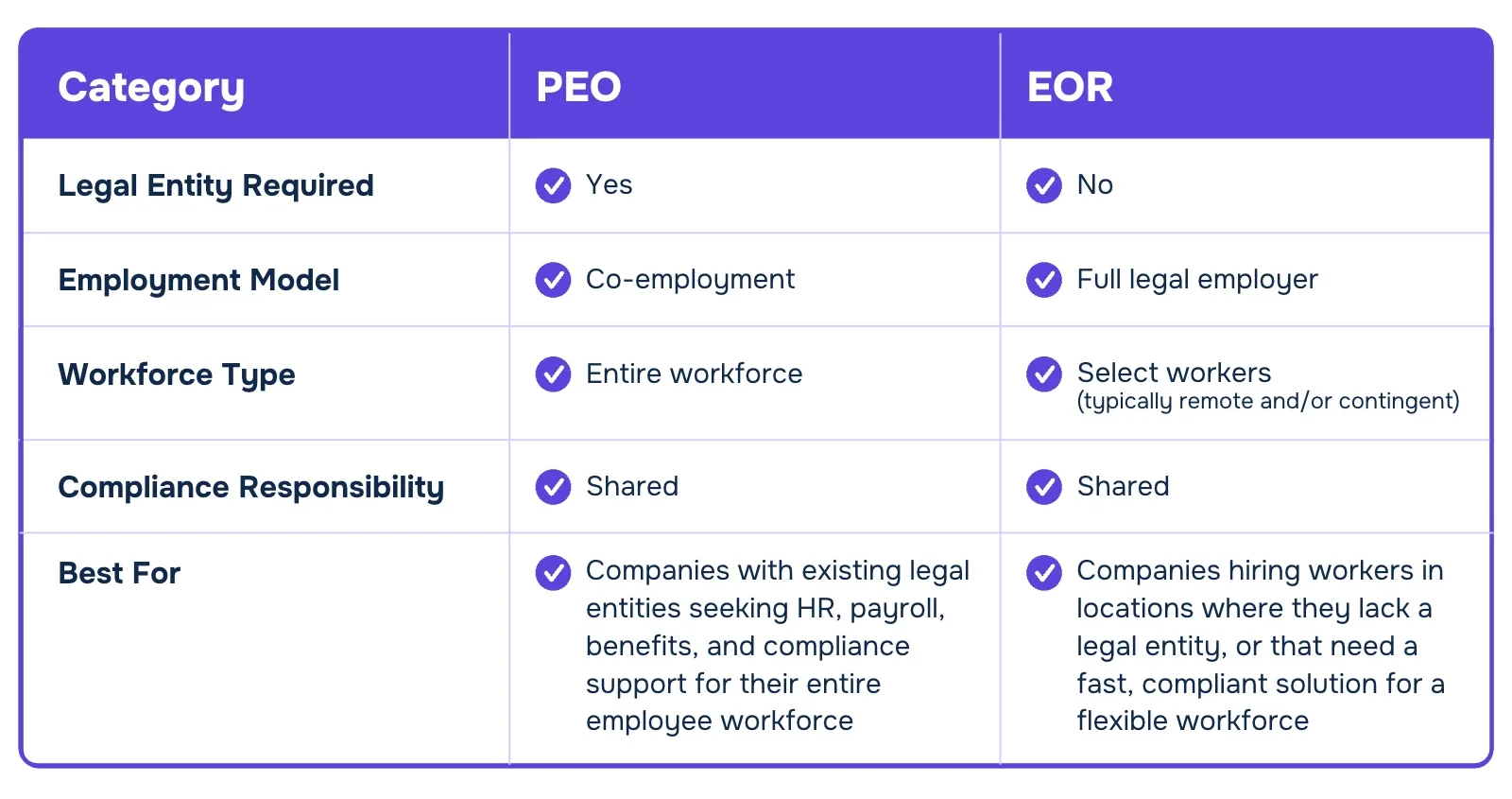
Which Employment Model Is Right for Your Business?
Companies often choose a PEO to outsource HR administration, benefits, and payroll support for their existing employee workforce. An EOR is typically used to solve geographic hiring challenges, enter new markets, support remote employees, or add flexibility to a broader workforce strategy that may include a mix of permanent employees and contingent workers.
The deciding factors are where you’re hiring, whether you already have a legal entity there, and whether you need to cover your entire workforce or a select group of workers. PEOs most often serve small and mid-sized companies with an established workforce in the locations where they already operate. EORs are often the stronger fit for organizations hiring across multiple states or countries, including global enterprises. The two models solve different problems, and many growing companies use both.
When to Use a PEO
- You have a legal entity and required employer registrations in the locations where employees work.
- Your workforce is established in stable locations, and you want one partner to support all of it.
- You want co-managed benefits under one plan.
- You want to offload HR, payroll, benefits, and compliance administration to a partner while keeping control of your employees and their daily work.
- You don’t have an in-house HR team, or your team is too small to manage HR administration on its own.
When to Use an EOR
- You are hiring talent in states or countries where you have no legal entity.
- You need to onboard global, contingent, or remote talent quickly.
- You want coverage for a select group of workers rather than your entire workforce.
- Your workforce includes hybrid, remote, temporary, and/or full-time roles.
- You want to test a new state or market before committing to a permanent entity.
- Speed and compliance flexibility are priorities.
- You want workforce flexibility without expanding your internal HR and compliance infrastructure.
Can You Use Both a PEO and an EOR?
Yes, many companies leverage both at once, using each for a different part of their workforce.
- The hybrid model: A PEO handles HR and payroll for your existing staff where you have an entity, while an EOR employs workers in states or countries where you don’t, along with your temporary or contingent hires.
- The distinction that matters: The two models cover different types of workers. A PEO covers your core staff. An EOR covers your remote and contingent workforce, plus any workers in locations where you have no entity.
- A common path: Companies often start with an EOR in a new location, then move those workers to their own entity or a PEO as the team grows. The EOR can remain a strategic partner for temporary, seasonal, or project-based contingent workers.
- When the hybrid makes sense: You want a PEO to manage HR, payroll, benefits, and compliance for your established workforce, while using an EOR to enable growth, workforce flexibility, and hiring in locations where creating or maintaining an entity is not practical.
Why Businesses Are Switching to IES
Innovative Employee Solutions (IES) provides full-service EOR solutions across all 50 U.S. states and 150+ countries, backed by over 50 years of workforce compliance experience. If you’re weighing a PEO vs. EOR for your next stage of growth, schedule a free, no-obligation discovery call to talk through which model fits your hiring needs.